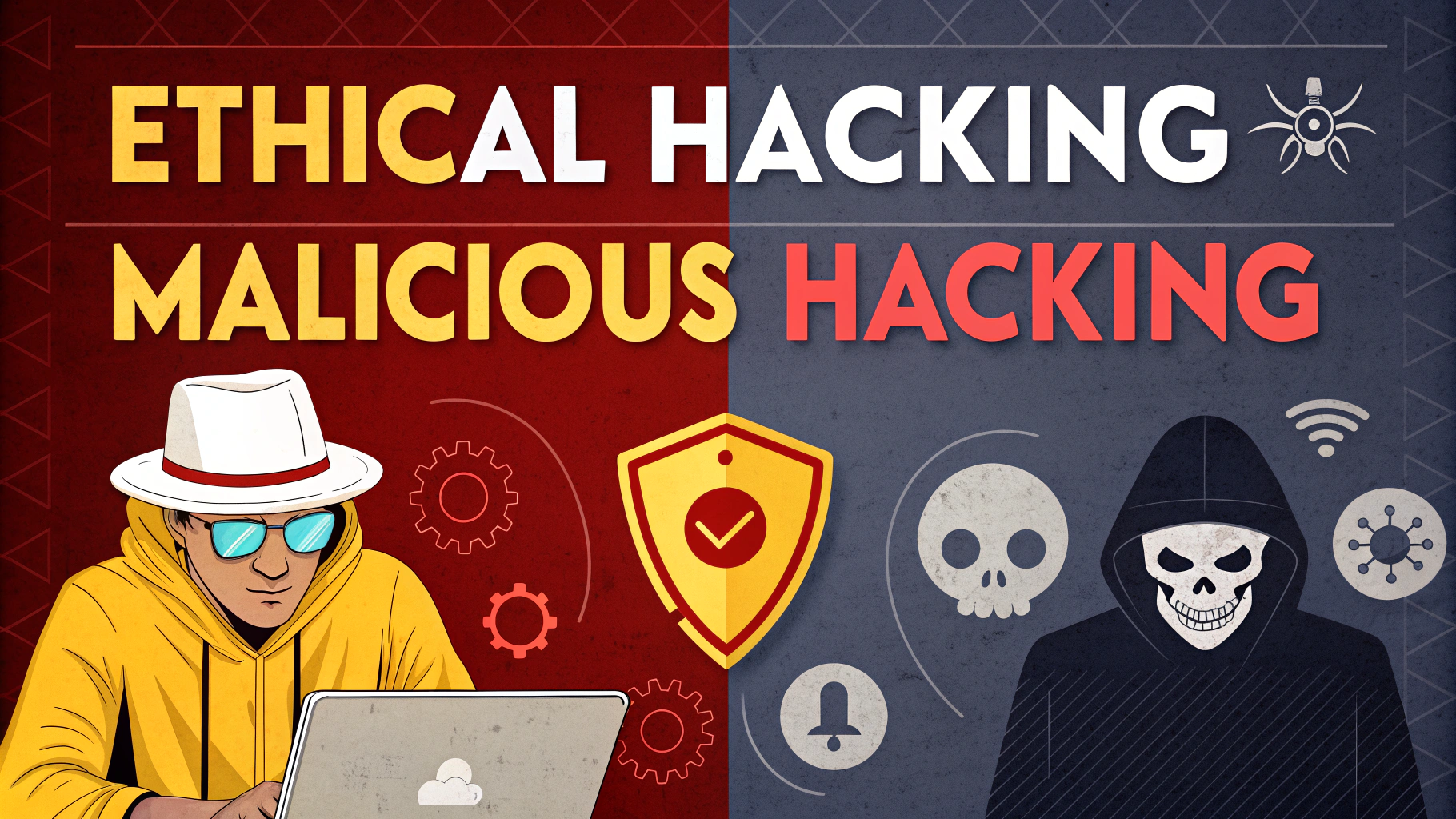
Ethical Hacking vs Malicious Hacking
Ethical hacking and malicious hacking represent opposite ends of the cybersecurity spectrum, with fundamentally different goals, methods, and legal im
Ethical Hacking vs Malicious Hacking
Ethical hacking and malicious hacking represent opposite ends of the cybersecurity spectrum, with fundamentally different goals, methods, and legal implications.
Key Differences at a Glance
Aspect
Ethical Hacking
Malicious Hacking
Legal Status
Legal, with permission
Illegal
Purpose
Improve security
Exploit vulnerabilities
Method
Structured, documented
Covert, undocumented
What Makes Ethical Hacking Different
- Written permission from target organization
- Clear scope and boundaries
- Detailed documentation and reporting
- Risk mitigation procedures
- Professional certification requirements
Common Ethical Hacking Services
- Penetration Testing
- Vulnerability Assessments
- Security Audits
- Red Team Exercises
Professional ethical hackers typically hold certifications like CEH (Certified Ethical Hacker) or OSCP (Offensive Security Certified Professional).
Legal Framework
Ethical hacking requires explicit written permission through contracts, NDAs, and scope documents before testing begins.
Professional Resources
Getting Started in Ethical Hacking
- Learn fundamental networking concepts
- Master basic programming skills
- Study common security tools
- Practice in legal environments (CTFs, labs)
- Obtain relevant certifications
Practice environments like HackTheBox and VulnHub offer legal ways to develop ethical hacking skills.
Warning Signs of Malicious Activity
- Unsolicited security testing
- Attempts to hide testing activities
- Refusal to provide documentation
- Testing outside agreed scope
Report suspected malicious hacking to relevant authorities and your organization’s security team immediately.
The Impact of Ethical Hacking
Ethical hacking plays a crucial role in modern cybersecurity by identifying and addressing vulnerabilities before malicious actors can exploit them.
Business Benefits
- Reduced security incident costs
- Enhanced customer trust
- Regulatory compliance
- Improved security awareness
- Proactive risk management
Industry Sectors Utilizing Ethical Hacking
- Financial Services
- Healthcare Organizations
- Government Agencies
- E-commerce Platforms
- Technology Companies
Best Practices for Organizations
Before Engagement
- Define clear testing boundaries
- Establish emergency procedures
- Verify tester credentials
- Sign necessary legal documents
- Prepare incident response plans
During Testing
- Maintain communication channels
- Monitor testing activities
- Document all findings
- Follow escalation procedures
Conclusion
Ethical hacking serves as a critical defense mechanism in cybersecurity strategy. Organizations must understand the distinction between ethical and malicious hacking while implementing proper protocols for security testing. Success in ethical hacking requires continuous learning, proper certification, and strict adherence to legal and professional standards.
Future Outlook
- Growing demand for certified professionals
- Expansion of automated testing tools
- Integration with AI and machine learning
- Enhanced focus on cloud security testing
- Evolution of compliance requirements
FAQs
- What is the main difference between ethical hacking and malicious hacking?
Ethical hacking is performed with explicit permission from the system owner to identify and fix security vulnerabilities, while malicious hacking is unauthorized access with intent to cause harm, steal data, or exploit systems. - What certifications are recognized for ethical hacking?
Certified Ethical Hacker (CEH), Offensive Security Certified Professional (OSCP), CompTIA PenTest+, and GIAC Penetration Tester (GPEN) are widely recognized ethical hacking certifications. - Is penetration testing the same as ethical hacking?
Penetration testing is a specific type of ethical hacking that involves systematically testing a computer system, network, or application to find vulnerabilities that could be exploited by malicious hackers. - What are the legal implications of ethical hacking?
Ethical hacking requires explicit written permission, often through contracts or scope agreements. Without proper authorization, even security testing can be considered illegal under computer crime laws. - What methodologies do ethical hackers follow?
Ethical hackers follow structured methodologies like OSSTMM (Open Source Security Testing Methodology Manual), PTES (Penetration Testing Execution Standard), and OWASP (Open Web Application Security Project) guidelines. - How do companies use ethical hacking services?
Companies employ ethical hackers through bug bounty programs, regular security assessments, compliance testing, and dedicated security teams to proactively identify and address security weaknesses. - What are the key tools used in ethical hacking?
Common tools include Nmap for network scanning, Metasploit for penetration testing, Wireshark for network analysis, Burp Suite for web application testing, and Kali Linux as an operating system. - What documentation is required for ethical hacking?
Ethical hackers must maintain detailed reports including scope agreements, testing methodologies, findings, vulnerability assessments, and remediation recommendations. - How do ethical hackers protect themselves legally?
They obtain written authorization, follow scope limitations strictly, document all activities, maintain confidentiality, and often carry professional liability insurance. - What are the phases of an ethical hacking engagement?
The phases include reconnaissance, scanning, gaining access, maintaining access, and clearing tracks, all while documenting findings and maintaining communication with the client.

Author: Editor

December 18, 2024
Related Posts
Tool Documentation Standards
documentation standards
Documentation standards ensure consistency, clarity, and effectiveness when recording findings during penetration testing engagements. Proper documentation helps security teams track vulnerabilities, communicate issues to stakeholders, and maintain an audit trail ... Read more
Testing Tool Integration
tool integration
Testing tool integration is a critical aspect of cybersecurity assessment that combines various security testing tools to create a more robust and comprehensive penetration testing workflow. Security professionals need efficient ... Read more
Automation Framework Design

automation framework
An automation framework streamlines and standardizes penetration testing processes, making security assessments more efficient and repeatable. Properly designed frameworks reduce manual effort while maintaining testing quality and consistency across different ... Read more
Exploitation Tool Development
tool development
Penetration testing tools require careful development to effectively identify security vulnerabilities in systems and networks. Security professionals need specialized exploitation tools that can safely simulate real-world attacks without causing damage. ... Read more
Security Tool Architecture
tool architecture
Security tool architecture forms the backbone of effective penetration testing, enabling security professionals to systematically probe systems for vulnerabilities. A well-structured security testing toolkit combines reconnaissance tools, vulnerability scanners, exploitation ... Read more
Build Server Security
build security
Security testing of build servers protects the foundation of software development and deployment processes from potential threats and vulnerabilities. Build servers handle sensitive data, access credentials, and control deployment pipelines, ... Read more
Secret Management

secrets management
Secret management stands as a cornerstone of cybersecurity, particularly during penetration testing operations where handling sensitive data requires meticulous care and precision. Penetration testers must safeguard various types of secrets ... Read more
Deployment Security

deployment security
Penetration testing during deployment phases helps organizations identify security vulnerabilities before applications go live. Security teams use automated and manual testing methods to simulate real-world attacks against newly deployed systems ... Read more