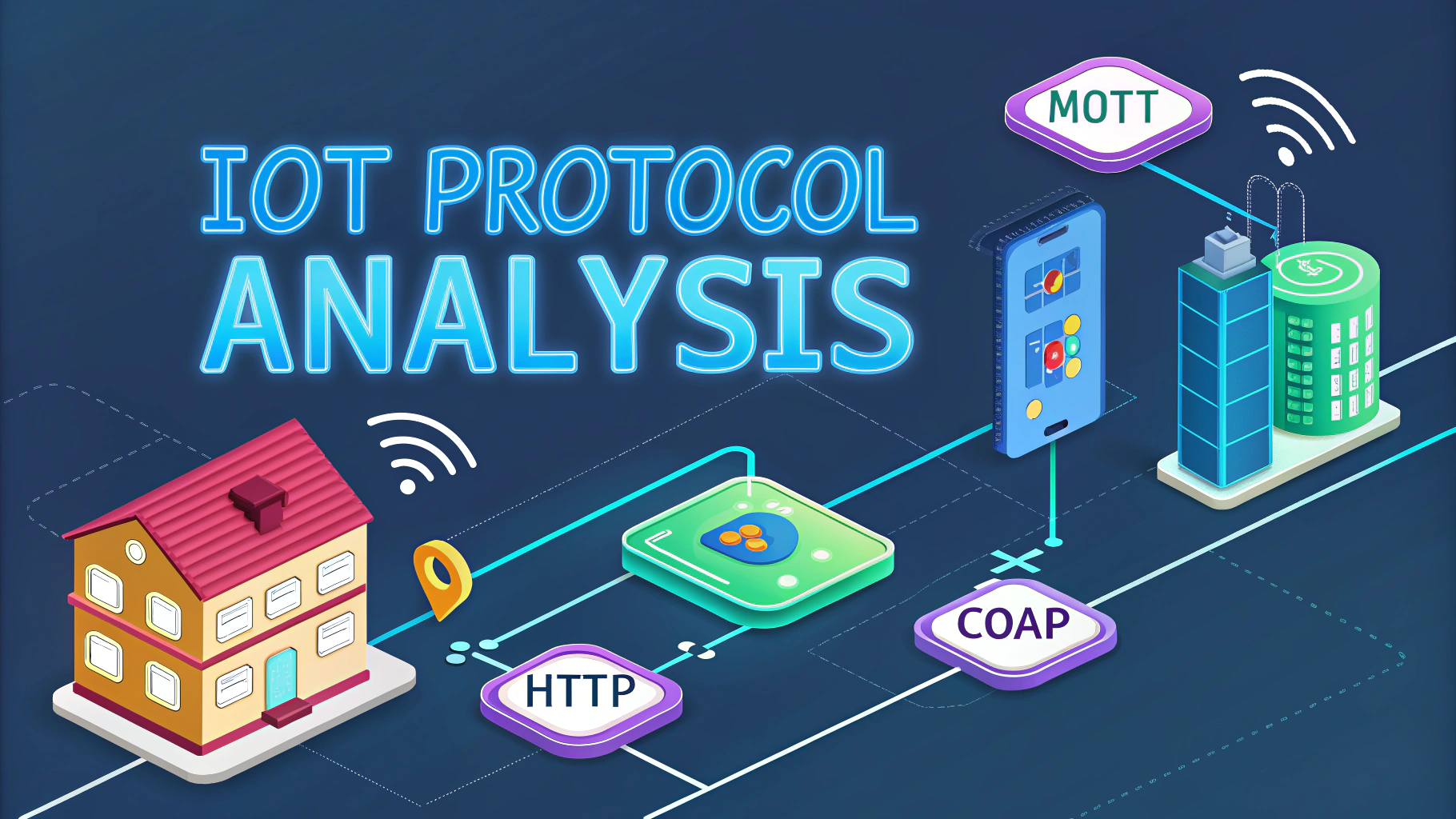
IoT Protocol Analysis
IoT protocols power the communication between connected devices, making them prime targets for security testing and analysis. A systematic approach to
IoT Protocol Analysis
IoT protocols power the communication between connected devices, making them prime targets for security testing and analysis.
A systematic approach to IoT protocol penetration testing helps identify vulnerabilities before malicious actors can exploit them.
This guide outlines key methods and tools for analyzing common IoT protocols like MQTT, CoAP, and other communication standards used in connected devices.
Common IoT Protocols to Test
- MQTT – Message Queuing Telemetry Transport
- CoAP – Constrained Application Protocol
- AMQP – Advanced Message Queuing Protocol
- DDS – Data Distribution Service
- HTTP/HTTPS – For REST APIs and web interfaces
- Zigbee – Low-power mesh networking protocol
- Z-Wave – Wireless communications protocol for home automation
Essential Testing Tools
- Wireshark – Network protocol analyzer for packet inspection
- MQTT.fx – MQTT client for testing broker connections
- Copper – CoAP testing tool
- Burp Suite – Web vulnerability scanner with IoT extensions
- Nmap – Network discovery and security auditing
- HackRF – Software-defined radio for RF protocol analysis
Protocol Analysis Steps
- Reconnaissance: Identify active protocols and ports
- Traffic Capture: Monitor protocol communications
- Authentication Testing: Check for weak credentials
- Encryption Analysis: Verify proper implementation
- Fuzzing: Test protocol handlers with malformed data
- Man-in-the-Middle Testing: Intercept and analyze communications
Security Checks for MQTT
- Test default credentials (username: admin, password: admin)
- Check broker authentication settings
- Verify TLS implementation
- Analyze ACL configurations
- Test topic structure security
- Monitor message retention policies
CoAP Security Testing
- Verify DTLS implementation
- Test resource discovery mechanisms
- Check request filtering
- Analyze response caching
- Test proxy configurations
Common Vulnerabilities
- Unencrypted communications
- Weak authentication mechanisms
- Insufficient access controls
- Hardcoded credentials
- Unpatched protocol implementations
- Insecure default configurations
Reporting and Documentation
Document all findings using a structured template that includes severity ratings, proof of concept, and remediation steps.
Severity Level
Description
Response Time
Critical
Direct system compromise possible
24 hours
High
Significant security impact
72 hours
Medium
Limited security impact
1 week
Low
Minimal security impact
2 weeks
Moving Forward with IoT Security
Regular protocol analysis should be part of an ongoing security assessment program for IoT deployments.
Contact your device manufacturer’s security team or visit IoT Security Foundation for specific guidance on protocol security best practices.
Best Practices for Protocol Testing
- Establish baseline protocol behavior before testing
- Use isolated test environments
- Document all test cases and results
- Maintain updated testing tools
- Follow responsible disclosure policies
- Regular security assessments
Compliance and Standards
- ETSI EN 303 645 – IoT security standard
- NIST SP 800-53 – Security controls
- ISO/IEC 27001 – Information security management
- OWASP IoT Top 10
Automated Testing Integration
CI/CD Pipeline Integration
- Automated protocol scanning
- Regular vulnerability assessments
- Compliance checking
- Security regression testing
Monitoring and Alerts
- Real-time protocol anomaly detection
- Security event logging
- Automated incident response
- Performance monitoring
Securing Tomorrow’s Connected World
IoT protocol security requires continuous adaptation as technologies evolve. Organizations must maintain vigilant testing procedures, implement security by design, and stay informed about emerging threats.
Regular protocol analysis combined with proper security controls helps build resilient IoT ecosystems that can withstand evolving cyber threats while maintaining operational efficiency.
Remember that protocol security is not a one-time effort but an ongoing process that requires regular updates, monitoring, and improvement to stay ahead of potential security risks.
FAQs
- What are the most common IoT protocols that need security testing?
MQTT, CoAP, AMQP, Zigbee, Z-Wave, BLE (Bluetooth Low Energy), and LoRaWAN are the primary protocols requiring security assessment in IoT penetration testing. - What tools are essential for IoT protocol penetration testing?
Wireshark, MQTT-PWN, CoAPthon, HCITool, BtleJuice, Zigdiggity, and Burp Suite are fundamental tools for analyzing and testing IoT protocol security. - How do you test MQTT broker security in IoT systems?
Test for authentication bypass, unauthorized subscription, message interception, default credentials, and malformed packet handling using tools like MQTT-PWN and Mosquitto clients. - What are the critical vulnerabilities in CoAP protocol implementations?
Common vulnerabilities include lack of DTLS implementation, unauthorized resource access, message replay attacks, and improper request validation. - How can BLE (Bluetooth Low Energy) protocols be tested for security weaknesses?
Test for authentication flaws, encryption weaknesses, MITM vulnerabilities, and improper pairing mechanisms using tools like GATTacker and BtleJuice. - What security aspects should be evaluated in Zigbee protocol testing?
Check for network key security, device authentication, encryption implementation, key management, and network join procedures using tools like KillerBee and Zigdiggity. - How do you assess LoRaWAN protocol security?
Evaluate network server security, key management, device authentication, message integrity, and encryption implementation using specialized LoRaWAN testing frameworks. - What are the common methods to intercept IoT protocol traffic?
Use network taps, ARP spoofing, wireless sniffers, protocol-specific proxies, and hardware interfaces like UART/JTAG to capture and analyze protocol traffic. - How do you test IoT protocol encryption implementation?
Analyze encryption algorithms used, key storage mechanisms, certificate validation, and protocol-specific security features using tools like Cryptanalyzer and protocol analyzers. - What are the best practices for IoT protocol fuzzing?
Implement structured and random fuzzing, test boundary conditions, malformed packets, and protocol state handling using tools like Peach Fuzzer and custom protocol fuzzers.

Author: Editor

January 17, 2025
Related Posts
Tool Documentation Standards
documentation standards
Documentation standards ensure consistency, clarity, and effectiveness when recording findings during penetration testing engagements. Proper documentation helps security teams track vulnerabilities, communicate issues to stakeholders, and maintain an audit trail ... Read more
Testing Tool Integration

tool integration
Testing tool integration is a critical aspect of cybersecurity assessment that combines various security testing tools to create a more robust and comprehensive penetration testing workflow. Security professionals need efficient ... Read more
Automation Framework Design

automation framework
An automation framework streamlines and standardizes penetration testing processes, making security assessments more efficient and repeatable. Properly designed frameworks reduce manual effort while maintaining testing quality and consistency across different ... Read more
Exploitation Tool Development

tool development
Penetration testing tools require careful development to effectively identify security vulnerabilities in systems and networks. Security professionals need specialized exploitation tools that can safely simulate real-world attacks without causing damage. ... Read more
Security Tool Architecture

tool architecture
Security tool architecture forms the backbone of effective penetration testing, enabling security professionals to systematically probe systems for vulnerabilities. A well-structured security testing toolkit combines reconnaissance tools, vulnerability scanners, exploitation ... Read more
Build Server Security

build security
Security testing of build servers protects the foundation of software development and deployment processes from potential threats and vulnerabilities. Build servers handle sensitive data, access credentials, and control deployment pipelines, ... Read more
Secret Management

secrets management
Secret management stands as a cornerstone of cybersecurity, particularly during penetration testing operations where handling sensitive data requires meticulous care and precision. Penetration testers must safeguard various types of secrets ... Read more
Deployment Security

deployment security
Penetration testing during deployment phases helps organizations identify security vulnerabilities before applications go live. Security teams use automated and manual testing methods to simulate real-world attacks against newly deployed systems ... Read more