
Enterprise Network Simulation
Network simulation and penetration testing combine to create secure enterprise environments through controlled virtual testing. Security professionals
Enterprise Network Simulation
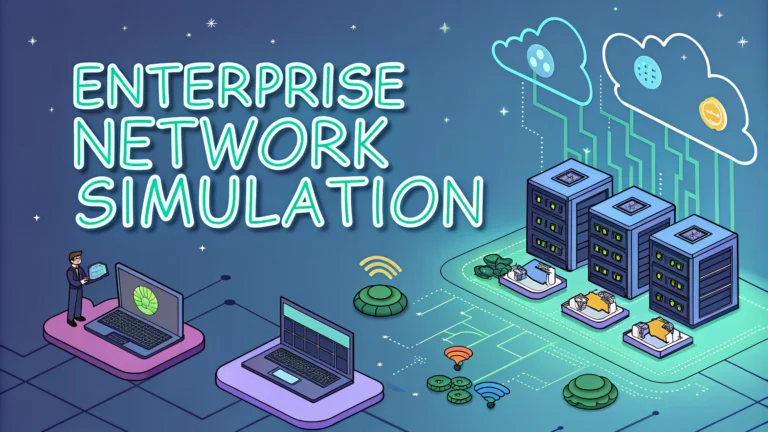
Network simulation and penetration testing combine to create secure enterprise environments through controlled virtual testing.
Security professionals use these tools to identify vulnerabilities before malicious actors can exploit them.
This guide covers essential network simulation techniques for effective penetration testing, focusing on practical applications and tools.
Setting Up a Test Environment
A proper test environment requires isolation from production networks to prevent accidental disruptions.
- VMware Workstation Pro or VirtualBox for virtualization
- GNS3 for network device emulation
- Packet Tracer for basic network topology design
- EVE-NG for advanced enterprise network simulation
Network Simulation Tools
Tool
Best For
Cost
GNS3
Cisco device simulation
Free
EVE-NG
Multi-vendor environments
Free/Premium
VIRL
Cisco-specific testing
Subscription
Essential Penetration Testing Components
- Reconnaissance tools: Nmap, Wireshark, tcpdump
- Exploitation frameworks: Metasploit, Canvas, Core Impact
- Vulnerability scanners: Nessus, OpenVAS, Nexpose
Building Realistic Test Scenarios
Start with basic network topologies and gradually increase complexity.
- Simulate common enterprise services (DNS, DHCP, Active Directory)
- Include security appliances (firewalls, IDS/IPS)
- Replicate production network traffic patterns
- Add common enterprise applications
Best Practices for Network Testing
Document all test procedures and results thoroughly.
- Create separate VLANs for different testing scenarios
- Use snapshots before major configuration changes
- Monitor resource usage during simulations
- Implement proper access controls
Common Testing Scenarios
- External network penetration attempts
- Internal network lateral movement
- Social engineering attack simulations
- Wireless network security assessment
- Data exfiltration testing
Resources and Training
- Online Labs: Hack The Box, VulnHub
- Certifications: OSCP, CEH, GPEN
- Communities: /r/netsec, /r/AskNetsec
Moving Forward with Network Security
Regular testing and simulation help maintain robust network security postures.
Schedule periodic assessments to identify new vulnerabilities as they emerge.
Keep simulation environments updated with current threats and attack vectors.
Advanced Testing Methodologies
Network security assessments require structured approaches to maximize effectiveness.
- Automated scanning combined with manual verification
- Custom exploit development for specific scenarios
- Integration of threat intelligence feeds
- Performance impact analysis
Reporting and Documentation
Technical Documentation
- Detailed vulnerability descriptions
- Proof-of-concept demonstrations
- Network topology diagrams
- Test case specifications
Executive Reporting
- Risk assessments and rankings
- Remediation recommendations
- Cost-benefit analysis
- Compliance implications
Continuous Improvement Cycle
Effective security testing requires ongoing refinement and updates.
- Regular framework updates and patch management
- Integration of new attack techniques
- Tool optimization and customization
- Team skill development and training
Strengthening Enterprise Security Through Simulation
Network simulation and penetration testing form the cornerstone of proactive security strategies.
- Maintain updated simulation environments reflecting current threats
- Implement lessons learned from each testing cycle
- Foster collaboration between security and network teams
- Build comprehensive security awareness programs
Organizations must continually evolve their testing methodologies to stay ahead of emerging threats and protect critical assets effectively.
FAQs
- What is Enterprise Network Simulation in penetration testing?
Enterprise Network Simulation in penetration testing is the process of creating a controlled virtual environment that replicates an organization’s network infrastructure to safely conduct security assessments and identify vulnerabilities. - What tools are commonly used for Enterprise Network Simulation?
Common tools include VMware vSphere, GNS3, EVE-NG, VIRL, VirtualBox, and Hyper-V for virtualization, along with specialized security tools like Metasploit, Nmap, and Wireshark for testing. - Why is network simulation important for penetration testing?
Network simulation allows security professionals to test attack scenarios, exploit vulnerabilities, and verify security controls without impacting production environments, reducing risk while maintaining testing accuracy. - What network components should be included in an enterprise simulation?
A comprehensive simulation should include firewalls, routers, switches, servers, workstations, security appliances, authentication systems, and representative network segments with appropriate VLANs and routing protocols. - How can you ensure simulation accuracy compared to the real network?
Accuracy is achieved by replicating actual network configurations, using identical software versions, implementing similar security policies, and maintaining equivalent network topology and traffic patterns. - What are the hardware requirements for running enterprise network simulations?
Hardware requirements typically include high-performance processors, substantial RAM (minimum 32GB recommended), fast storage systems, and multiple network interfaces to support multiple virtual machines and network devices. - How do you simulate realistic network traffic during penetration testing?
Traffic generation tools like Ostinato, Cisco TRex, or custom scripts can be used to create realistic network traffic patterns, including legitimate user activities and background network noise. - What are the common challenges in enterprise network simulation?
Common challenges include resource limitations, performance overhead of virtualization, accurately replicating complex protocols, maintaining synchronized configurations, and simulating realistic user behavior patterns. - How should sensitive data be handled in network simulations?
Use sanitized or synthetic data that mirrors production data structures but contains no actual sensitive information. Implement the same security controls as production environments to test their effectiveness. - What documentation should be maintained for network simulations?
Documentation should include network diagrams, configuration files, test scenarios, discovered vulnerabilities, mitigation strategies, and detailed reports of findings and recommendations.

Author: Editor

February 6, 2025
Related Posts
Tool Documentation Standards
documentation standards
Documentation standards ensure consistency, clarity, and effectiveness when recording findings during penetration testing engagements. Proper documentation helps security teams track vulnerabilities, communicate issues to stakeholders, and maintain an audit trail ... Read more
Testing Tool Integration
tool integration
Testing tool integration is a critical aspect of cybersecurity assessment that combines various security testing tools to create a more robust and comprehensive penetration testing workflow. Security professionals need efficient ... Read more
Automation Framework Design

automation framework
An automation framework streamlines and standardizes penetration testing processes, making security assessments more efficient and repeatable. Properly designed frameworks reduce manual effort while maintaining testing quality and consistency across different ... Read more
Exploitation Tool Development
tool development
Penetration testing tools require careful development to effectively identify security vulnerabilities in systems and networks. Security professionals need specialized exploitation tools that can safely simulate real-world attacks without causing damage. ... Read more
Security Tool Architecture
tool architecture
Security tool architecture forms the backbone of effective penetration testing, enabling security professionals to systematically probe systems for vulnerabilities. A well-structured security testing toolkit combines reconnaissance tools, vulnerability scanners, exploitation ... Read more
Build Server Security
build security
Security testing of build servers protects the foundation of software development and deployment processes from potential threats and vulnerabilities. Build servers handle sensitive data, access credentials, and control deployment pipelines, ... Read more
Secret Management

secrets management
Secret management stands as a cornerstone of cybersecurity, particularly during penetration testing operations where handling sensitive data requires meticulous care and precision. Penetration testers must safeguard various types of secrets ... Read more
Deployment Security
deployment security
Penetration testing during deployment phases helps organizations identify security vulnerabilities before applications go live. Security teams use automated and manual testing methods to simulate real-world attacks against newly deployed systems ... Read more