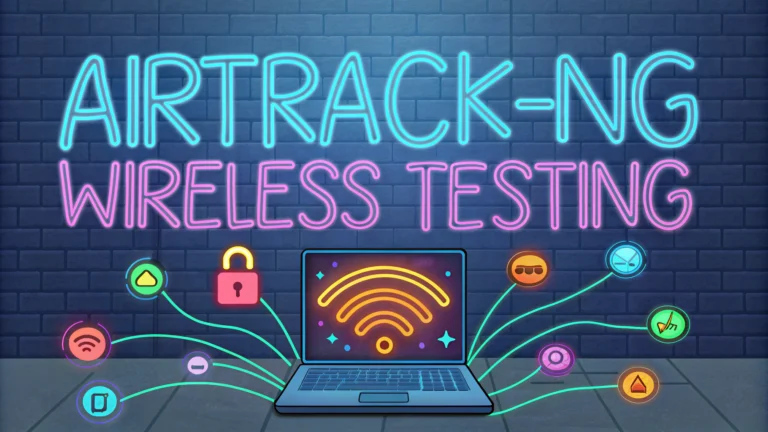
Aircrack-ng stands as one of the most powerful open-source tools for testing wireless network security.
This quick guide covers the essential steps to effectively use Aircrack-ng for ethical network testing and security assessment.
What is Aircrack-ng?
Aircrack-ng is a complete suite of tools for assessing WiFi network security, including packet capture, attack detection, and testing for various wireless vulnerabilities.
Key Components:
- airmon-ng: Enables monitor mode on wireless interfaces
- airodump-ng: Packet capture tool for raw 802.11 frames
- aireplay-ng: Generates wireless traffic for WEP/WPA cracking
- aircrack-ng: The main tool for cracking WEP and WPA-PSK keys
Basic Setup Requirements
- Compatible wireless network adapter supporting packet injection
- Linux-based operating system (Kali Linux recommended)
- Root/administrative privileges
- Basic command line knowledge
Getting Started
Install Aircrack-ng using: sudo apt-get install aircrack-ng
Step-by-Step Usage:
- Start monitor mode:
airmon-ng start wlan0 - Scan networks:
airodump-ng wlan0mon - Capture packets:
airodump-ng -c [channel] --bssid [target_MAC] -w output wlan0mon
Security Best Practices
- Only test networks you own or have explicit permission to test
- Document all testing activities
- Keep software updated to latest versions
- Use in conjunction with other security tools for comprehensive testing
Common Issues and Solutions
| Issue | Solution |
|---|---|
| Monitor mode fails | Kill interfering processes: airmon-ng check kill |
| No packets captured | Verify correct channel and proximity to target network |
Additional Resources
Remember that unauthorized network testing is illegal in most jurisdictions and could result in serious legal consequences.
Advanced Techniques
WPA2 Handshake Capture
Capturing WPA2 handshakes requires specific timing and techniques:
- Target specific network:
airodump-ng -c [channel] --bssid [target_MAC] -w capture wlan0mon - Force reconnection:
aireplay-ng -0 2 -a [target_MAC] wlan0mon
Performance Optimization
- Use GPU acceleration for faster processing
- Optimize capture filters for relevant traffic
- Position antenna for optimal signal strength
- Monitor system resources during intensive operations
Troubleshooting
| Problem | Resolution |
|---|---|
| Slow packet capture | Adjust frequency band and channel width |
| Driver compatibility issues | Update or patch wireless drivers |
Conclusion
Aircrack-ng remains an essential tool for network security professionals and system administrators. Its effectiveness depends on proper configuration, understanding of wireless protocols, and adherence to legal and ethical guidelines.
Key Takeaways:
- Always obtain proper authorization before testing
- Maintain updated tools and documentation
- Follow security best practices consistently
- Use responsibly as part of a comprehensive security strategy
FAQs
- What is Aircrack-ng and what is its primary purpose?
Aircrack-ng is a complete suite of tools for assessing WiFi network security. It focuses on different areas of WiFi security including monitoring, attacking, testing, and cracking. - Which operating systems support Aircrack-ng?
Aircrack-ng runs on Linux, Windows, macOS, FreeBSD, OpenBSD, NetBSD, and Solaris. However, it performs best and has the most features when used on Linux-based systems. - What are the main tools included in the Aircrack-ng suite?
The suite includes airmon-ng (wireless card monitor mode), airodump-ng (packet capture), aireplay-ng (packet injection), aircrack-ng (WEP/WPA cracking), and airdecap-ng (decrypt captured files). - What types of wireless encryption can Aircrack-ng crack?
Aircrack-ng can crack WEP (40 and 104 bit keys), and WPA/WPA2-PSK. It cannot crack WPA/WPA2-Enterprise that uses proper server authentication. - What hardware requirements are needed to use Aircrack-ng effectively?
A wireless network adapter that supports monitor mode and packet injection is required. Popular chipsets include Atheros, Realtek RTL8187, and some Ralink chips. - How does Aircrack-ng crack WPA/WPA2 passwords?
It uses dictionary or brute force attacks after capturing a WPA handshake between a client and access point. The success depends on whether the password exists in the wordlist being used. - Is Aircrack-ng legal to use?
Aircrack-ng is legal to use for authorized security testing and network auditing. However, using it to break into networks without permission is illegal in most jurisdictions. - What is the difference between monitor mode and managed mode in wireless testing?
Monitor mode allows the wireless card to capture all wireless packets in range without being associated with an access point, while managed mode is the normal client mode used to connect to networks. - How can I tell if my wireless card is compatible with Aircrack-ng?
Check the Aircrack-ng compatibility list on their official website, or test if your card supports monitor mode using the airmon-ng command. - What is a handshake capture and why is it important?
A handshake capture contains the encrypted authentication process between a client and access point. It’s required for attempting to crack WPA/WPA2 passwords offline.