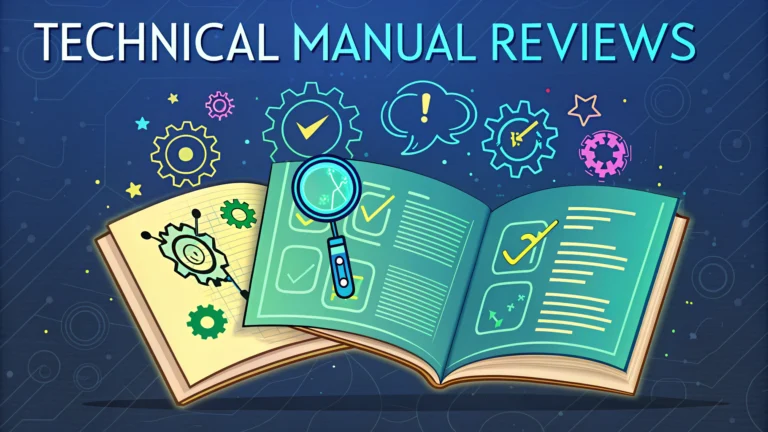
Technical manual reviews help discover security flaws by examining documentation, specifications, and source code without actually executing the software.
A thorough technical review process identifies potential vulnerabilities early in the development lifecycle, reducing remediation costs significantly compared to finding issues in production.
Manual code reviews complement automated scanning tools by uncovering complex security issues that automated analysis might miss, like business logic flaws and authorization bypass vulnerabilities.
Key Components of Technical Manual Reviews
- Architecture and design documentation analysis
- Source code security review
- Configuration file examination
- API documentation assessment
- Security control verification
Review Methodology
Start with high-level architecture documents to understand data flows, trust boundaries, and security controls.
Review source code using a checklist-based approach focusing on common vulnerability patterns like OWASP Top 10.
Examine configuration files for security misconfigurations, hardcoded credentials, and insecure default settings.
Tools and Resources
- Code Review Tools: SonarQube, Fortify, Checkmarx
- Documentation: OWASP Code Review Guide, SANS Secure Coding Guidelines
- Checklists: OWASP Application Security Verification Standard (ASVS)
Common Issues to Look For
| Category | Examples |
|---|---|
| Authentication | Weak password policies, insecure storage, missing MFA |
| Authorization | Missing access controls, IDOR vulnerabilities |
| Data Protection | Unencrypted sensitive data, weak cryptographic implementations |
Documentation Best Practices
- Maintain detailed findings logs with severity ratings
- Include proof-of-concept examples for vulnerabilities
- Provide clear remediation steps
- Track findings through resolution
Next Steps After Review
Prioritize findings based on risk level and potential business impact.
Create detailed remediation plans with specific technical recommendations.
Schedule follow-up reviews to verify fixes and identify any new issues.
Taking Action on Findings
Document each finding with a clear description, risk rating, and recommended fix.
Establish timelines for addressing critical and high-risk vulnerabilities.
Implement a verification process to ensure proper remediation of identified issues.
Resources for Further Learning
Review Team Composition
Establish cross-functional teams including security experts, developers, and domain specialists for comprehensive coverage.
Rotate reviewers to maintain fresh perspectives and share knowledge across the organization.
Key Team Roles
- Security Lead – Oversees review process and methodology
- Technical Reviewers – Perform detailed code analysis
- Subject Matter Experts – Provide domain-specific insights
- Quality Assurance – Verify findings and fixes
Continuous Improvement Process
Implement feedback loops to enhance review effectiveness and efficiency over time.
Track metrics like detection rates, false positives, and time-to-remediation to measure progress.
- Regular methodology updates based on emerging threats
- Integration of lessons learned into security training
- Refinement of review checklists and procedures
Integration with Development Lifecycle
Embed manual review checkpoints within the development pipeline to catch issues early.
Coordinate with development teams to establish review gates before major releases.
Strengthening Security Through Knowledge
Regular technical reviews build institutional knowledge about security vulnerabilities and best practices.
Share findings across teams to prevent similar issues in future development.
- Create internal knowledge bases of common vulnerabilities
- Develop secure coding guidelines based on review findings
- Foster a security-first development culture
FAQs
- What is a technical manual review in penetration testing?
A technical manual review is a systematic examination of system documentation, configurations, architecture diagrams, and code to identify potential security vulnerabilities without actively exploiting them. - What are the key components typically reviewed during a manual technical review?
Key components include source code, configuration files, API documentation, network diagrams, security policies, authentication mechanisms, access control matrices, and deployment procedures. - How does manual review differ from automated scanning in penetration testing?
Manual review allows for context-aware analysis, detection of logical flaws, and identification of complex vulnerabilities that automated tools might miss, while requiring more expertise and time. - What qualifications should a technical manual reviewer possess?
Reviewers should have strong programming knowledge, understanding of security protocols, familiarity with common vulnerability patterns, system architecture expertise, and relevant security certifications. - What documentation should be produced during a technical manual review?
Documentation should include findings reports, vulnerability assessments, risk ratings, remediation recommendations, and technical evidence supporting each discovered vulnerability. - How does OWASP’s guidance factor into technical manual reviews?
OWASP guidelines provide a framework for identifying common vulnerabilities, testing methodologies, and security controls that should be evaluated during manual reviews. - What are the most critical areas to focus on during a technical manual review?
Critical areas include authentication mechanisms, session management, access controls, data validation, encryption implementations, and security-critical business logic. - How often should technical manual reviews be conducted?
Reviews should be conducted after major system changes, during security assessments, before production deployments, and at regular intervals as defined by security policies. - What are common challenges in technical manual reviews?
Challenges include incomplete documentation, complex systems, time constraints, legacy code understanding, and keeping up with evolving security threats and best practices. - What tools complement manual technical reviews?
Static code analysis tools, configuration review tools, documentation generators, and vulnerability databases complement manual review processes.